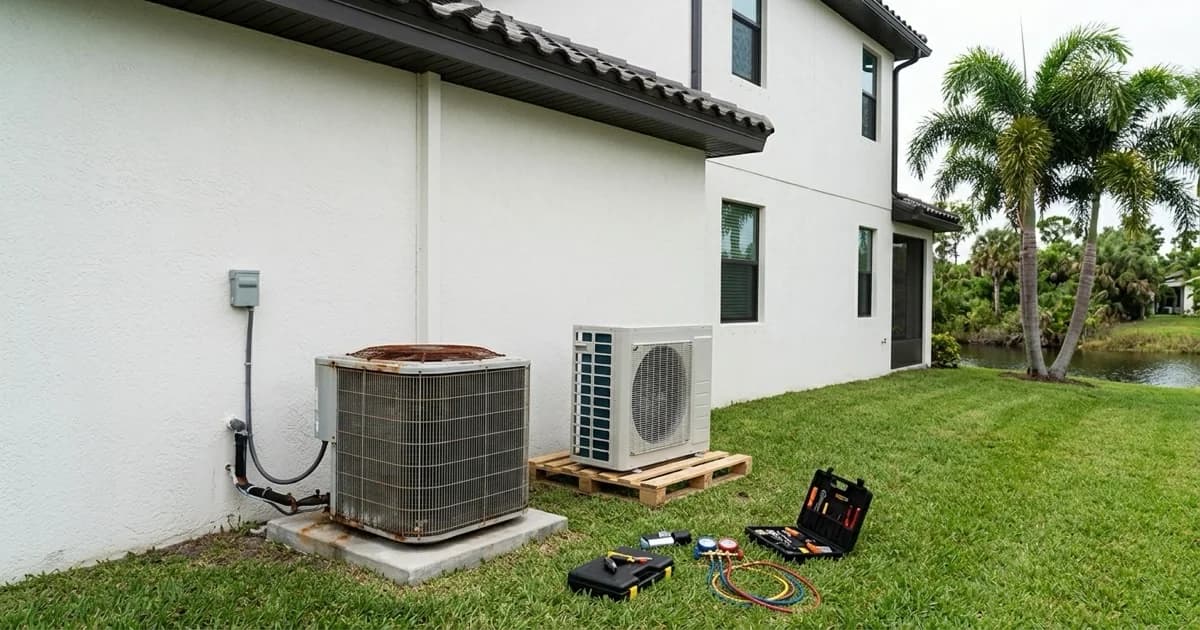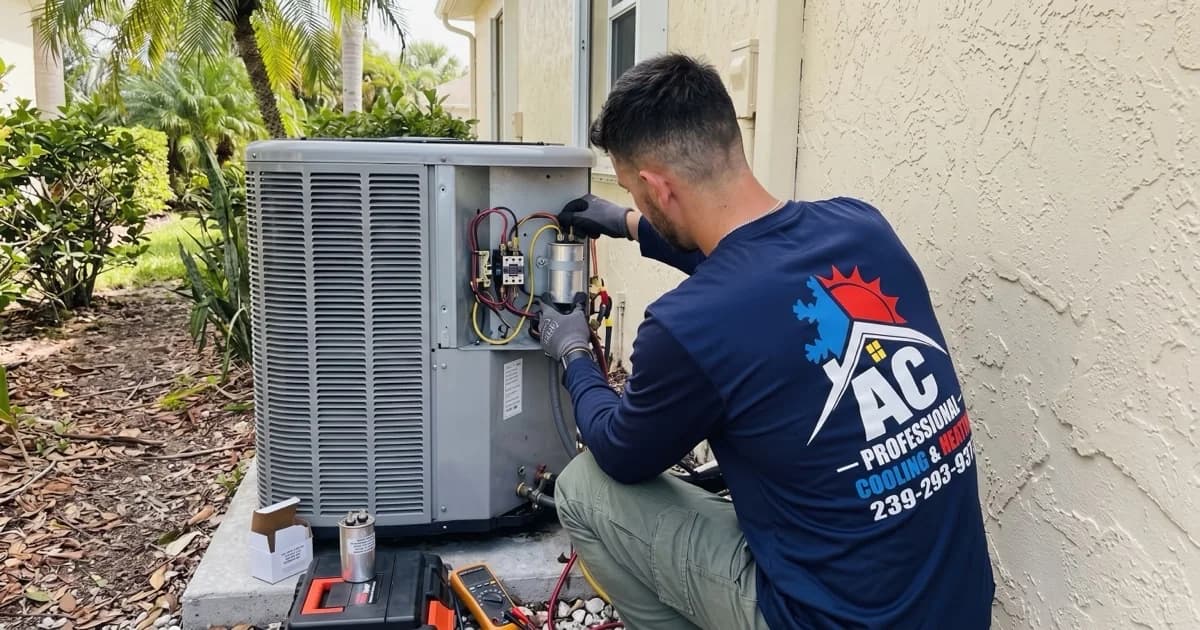

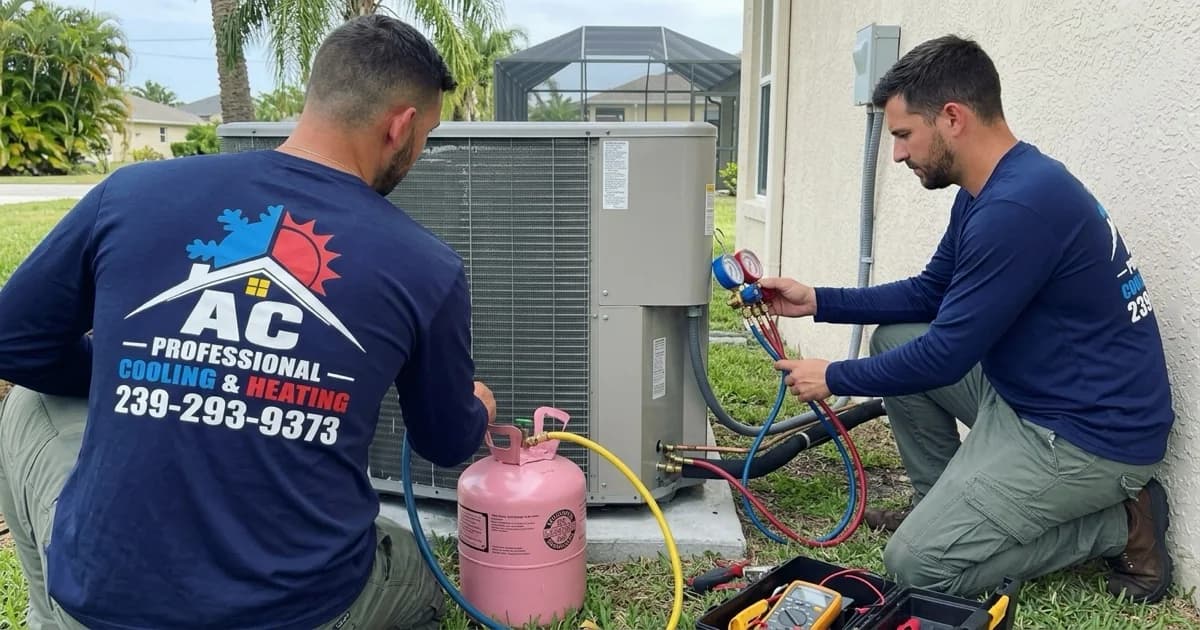
This guide covers what a freon recharge actually costs in Cape Coral, Fort Myers, and Naples, why your system is low, leak repair pricing, the R-22 vs. R-410A vs. R-454B situation in 2026, and a clear decision framework for when to repair versus replace.
How Much Does an AC Recharge Cost in Southwest Florida? (2026)
In Cape Coral, Fort Myers, and Naples, most homeowners pay between $200 and $600 for an R-410A refrigerant recharge in 2026. R-22 systems cost significantly more due to supply restrictions.
| Service | Typical Cost (SWFL 2026) | What's Included |
|---|---|---|
| Diagnostic + leak search | Call (239) 293-9373 | Electronic leak detection, system pressure test |
| R-410A recharge (per lb) | $50–$150/lb | Refrigerant + labor (AIM Act volatility) |
| R-410A full recharge (typical) | $200–$600 | 2–5 lbs + labor |
| R-22 recharge (per lb) | $100–$150/lb (recycled supply only) | Limited availability, price volatile |
| R-22 full recharge (typical) | $600–$1,500+ | 3–7 lbs + labor + scarcity premium |
| Leak repair — valve/fitting | $150–$400 | Service port valve, line fitting |
| Leak repair — line set | $200–$650 | Copper line repair or section replacement |
| Leak repair — evaporator coil | $400–$1,500 | Coil repair or replacement |
| Leak repair — condenser coil | $500–$1,800 | Outdoor coil repair or replacement |
Cost data sourced from Angi and HomeGuide. These ranges reflect Southwest Florida pricing.
AC Professional's Protection Plan includes priority scheduling and discounts on refrigerant services. Call (239) 293-9373 for current pricing and plan details.
Why Your AC Is Low on Refrigerant (It's Always a Leak)
Your air conditioner is a sealed system. Refrigerant circulates but is never consumed — the same charge should last the lifetime of the unit. If a technician says your system is low on refrigerant, that means it leaked out somewhere. Recharging without finding and fixing the leak is like refilling a tire with a nail in it.
In Southwest Florida, formicary corrosion is a leading cause of evaporator coil leaks. According to the Copper Development Association, this type of corrosion is caused by formic acid from everyday household chemicals (cleaners, air fresheners, adhesives) reacting with copper tubing in humid environments. Florida's year-round humidity accelerates the process, eating through coils from the inside out.
Coastal properties in Cape Coral, Fort Myers, and Naples face additional salt-air corrosion. Combined with 3,500+ hours of annual runtime (ENERGY STAR estimates for southern climates), even a small leak depletes refrigerant two to three times faster than in a cooler climate. Learn more about protecting your coils in our AC coil cleaning guide.
7 Signs Your AC Is Low on Refrigerant
- Warm air from supply vents. AC runs but can't reach the temperature you set.
- Ice on refrigerant lines or indoor coil. Low pressure drops the coil below freezing.
- Hissing or bubbling sounds. Refrigerant escaping through a leak point.
- System runs continuously without cooling. The compressor can't keep up with the thermostat.
- Higher electric bills without explanation. A system low on refrigerant runs longer cycles to compensate.
- Indoor humidity above 55%. Low refrigerant means your AC can't pull enough moisture from the air.
- Oily residue near refrigerant lines. Refrigerant oil escapes with gas through leaks.
The Real Cost of Just Topping Off
If you pay $350 for a top-off today and the leak loses 2 lbs per season, you'll spend $1,050 over three years — plus energy waste. Fix the leak once for $200–$650 and the problem is solved.
5 Questions to Ask Before Authorizing a Recharge
- Did you find the leak?
- What leak detection method did you use?
- What's the repair cost vs. recharge-only cost?
- How many pounds did the system lose?
- Will you pressure-test after the repair?
Recharge vs. Leak Repair vs. Replacement — Which Makes Sense?
| System Age | Refrigerant | Leak Location | Recommendation |
|---|---|---|---|
| Under 8 years | R-410A | Valve/fitting | Repair the leak — system has years left |
| 8–12 years | R-410A | Evaporator coil | Evaluate: coil vs. system replacement |
| Any age | R-22 | Any location | Strongly consider replacement |
| 12+ years | Any | Any | Apply the $5,000 rule |
| 2nd recharge in 2 years | Any | Recurring | Replace — ongoing leak indicates deterioration |
The $5,000 rule: multiply repair cost by system age. If result exceeds $5,000, replacement is typically better.
Call AC Professional at (239) 293-9373 for current diagnostic pricing. We give you the repair cost in writing before any work starts.
R-22, R-410A and R-454B — What Your Refrigerant Type Means in 2026
Note: "Freon" is a brand name originally associated with R-22. Most modern AC systems use R-410A, which is not Freon. Check the data plate on your outdoor unit to identify your refrigerant type.
| Refrigerant | EPA Status | Availability | Cost per lb (2026) | Environmental Impact |
|---|---|---|---|---|
| R-22 | Banned since 2020 | Recycled supply only | $100–$150/lb | High (ozone depleting) |
| R-410A | 40% phase-down since Jan 2025 | Still available, prices rising | $50–$150/lb | Moderate |
| R-454B | New standard from 2025 | Growing availability | Market pricing | 68% lower impact than R-410A |
Prices are volatile due to the AIM Act supply restrictions. Your technician can confirm current rates.
Can You Recharge Your Home AC Yourself?
No. Only EPA Section 608 certified technicians can legally handle residential AC refrigerant. Releasing refrigerant into the air carries fines up to $44,539 per day under the Clean Air Act. Those DIY recharge cans you see at auto parts stores are for car AC only, not home systems. Adding too much refrigerant damages the compressor, which costs $2,000–$3,500 to replace.
What Happens During a Professional Refrigerant Service Visit
- Diagnostic — check thermostat, airflow, and electrical connections
- Leak detection — electronic detector, pressure test, or UV dye to find exactly where the leak is
- Written quote — you see the cost before any work starts
- Repair the leak — fix the actual problem, not just the symptom
- Pressure test — verify the repair holds and no other leaks exist
- Remove trapped air and moisture — clean the system before adding refrigerant
- Weigh-in the exact charge — add the precise amount your system needs by weight
- Performance check — verify the system is cooling to manufacturer specifications
AC Professional provides the written estimate at step 3. Call (239) 293-9373.
When Is the Best Time to Recharge Your AC in Southwest Florida?
If your system has a leak, don't wait. In Southwest Florida, AC runs 9 to 10 months per year. A slow leak that starts in spring will drain your refrigerant by the peak of summer (June through September), when you need cooling the most and HVAC companies are at their busiest.
Schedule your diagnostic before May to avoid emergency pricing and longer wait times during peak season. AC Professional offers priority scheduling for Protection Plan members.
The Bottom Line
Your AC should never need a refrigerant recharge under normal conditions. If it does, you have a leak. The smartest investment is finding and fixing that leak, not just topping off the refrigerant and hoping for the best.
Use the decision table above, apply the $5,000 rule (a widely used HVAC industry guideline), and get a written diagnosis before spending money. If your system uses R-22, replacement is almost always the better financial decision in 2026.
Updated October 2026. Cost ranges reflect Southwest Florida market pricing sourced from [Angi](https://www.angi.com/articles/ac-recharge-cost.htm) and [HomeGuide](https://homeguide.com/costs/ac-freon-cost). Call (239) 293-9373 for AC Professional's current rates.