
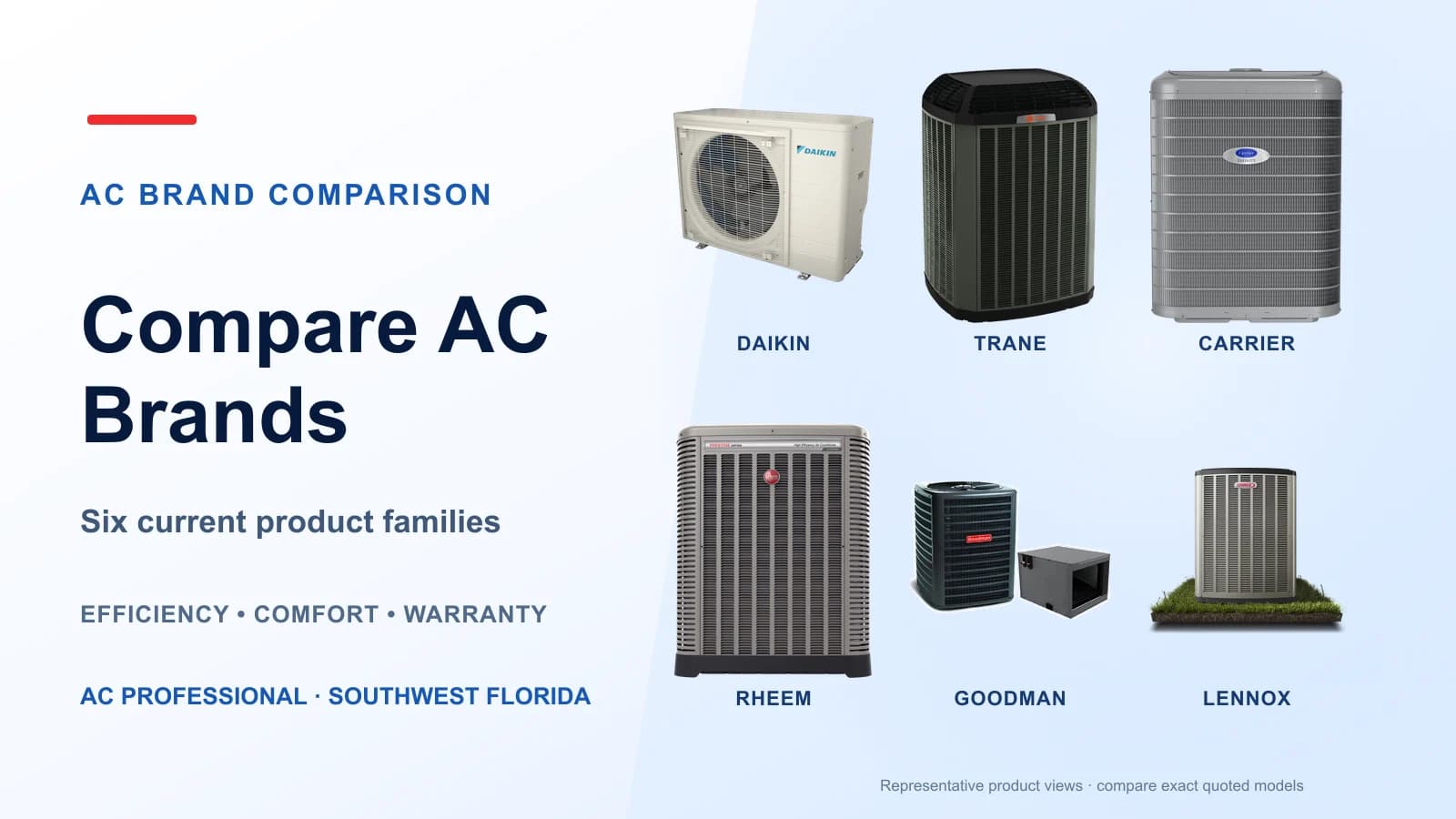
If you are trying to compare AC brands Southwest Florida homeowners often ask about, the smartest approach is not to look for one universal winner. Daikin, Trane, Carrier, Rheem, Goodman, and Lennox all sell multiple product tiers, and the final result depends just as much on the exact model and installation as it does on the name on the cabinet.
In Southwest Florida, that matters even more. Long cooling seasons, high humidity, and salt exposure can all affect comfort, maintenance needs, and how well a system holds up over time. A good comparison should focus on what you can verify before you buy, what your contractor should measure, and what the written proposal actually includes.
If you want help comparing options for your home in Cape Coral, Fort Myers, North Fort Myers, Naples, Bonita Springs, or Estero, AC Professional can provide a free estimate and explain the differences in plain English.
Why brand comparisons can be misleading
Brand names are easy to compare, but they do not tell the whole story. Each manufacturer offers entry-level, mid-tier, and higher-feature systems, and those product lines can differ a lot in comfort features, controls, and installation requirements.
That means two systems from the same brand can perform very differently in the same house. A well-sized, properly installed lower-tier system may outperform a poorly designed premium system if the ductwork, airflow, and refrigerant setup are not right.
For that reason, a homeowner should compare the full proposal, not just the logo. The exact model, the indoor and outdoor match, and the quality of the installation design all matter.
What to compare first: the exact model and system design
Before you compare Daikin vs Trane vs Carrier, or Rheem vs Goodman vs Lennox, ask for the exact model numbers. That lets you compare the real equipment instead of broad marketing claims.
A useful comparison should include:
- The indoor unit and outdoor unit model numbers
- Whether the system is matched as a complete setup
- The thermostat or control package
- Any accessories included in the proposal
- The ductwork or airflow changes needed for proper operation
This is also where installation quality becomes central. If the system is not sized correctly or the airflow is off, the homeowner may notice uneven temperatures, short cycling, higher humidity, or more frequent service calls. Those issues are often installation-related, not brand-related.
Daikin vs Trane vs Carrier: what homeowners should verify
Daikin, Trane, and Carrier are often compared by shoppers who want a premium or feature-rich system. But the right question is not which one is “best” in general. The better question is which exact model fits your home, your comfort goals, and your installation conditions.
When comparing these three brands, verify:
- The exact model tier being quoted
- How the system handles humidity control
- Whether the thermostat or controls match your preferences
- What installation changes are needed for your home
- How the written warranty terms are stated on the proposal
In Southwest Florida, comfort is not only about temperature. If a system cools the house but leaves it feeling sticky, the homeowner may not be satisfied even if the brand is highly regarded. Ask how the proposed system is expected to manage humidity during long cooling seasons.
For more brand-specific background, see our guides on Daikin AC systems in Southwest Florida, Trane AC systems in Southwest Florida, and Carrier AC systems in Southwest Florida.
Rheem vs Goodman vs Lennox: how to compare value and fit
Rheem, Goodman, and Lennox are also sold in multiple tiers, so shoppers should avoid assuming that one name automatically means better value. A lower-cost proposal may still be a smart choice if the model fits the home and the installation scope is clear. A higher-feature system may be worth considering if the controls, comfort features, and design match your needs.
When comparing these brands, ask about:
- The exact equipment match and model tier
- The thermostat compatibility with your preferred controls
- The required electrical, airflow, or duct changes
- The written warranty terms for the specific equipment being installed
- What is included in the total installed scope
If you are comparing a more budget-conscious option to a more feature-rich one, the key is to understand what changes from one proposal to the next. Sometimes the difference is not just the equipment itself, but the installation design, accessories, or control package.
You can also review our brand guides for Rheem AC systems in Southwest Florida, Goodman AC systems in Southwest Florida, and Lennox AC systems in Southwest Florida.
Efficiency, sound, and humidity control are not the same thing
Many homeowners focus on efficiency first, but that is only one part of the decision. A system can have a strong efficiency rating on paper and still be the wrong fit if it is noisy, does not control humidity well, or requires a thermostat setup you do not want.
Sound matters in Southwest Florida because outdoor units often run frequently during the cooling season. If the condenser is near a patio, bedroom, or neighbor’s property line, ask how the proposed model is expected to sound in real-world use.
Humidity control matters too. A system that runs too quickly may cool the air before it removes enough moisture. That can leave the home feeling less comfortable even when the thermostat is set correctly. A proper load calculation and correct equipment sizing help reduce that risk.
Thermostat compatibility and controls
The thermostat is part of the system, not an afterthought. Some homeowners want simple controls, while others want more advanced scheduling or app-based features. The right choice depends on the exact equipment and how the system is installed.
Before you approve a proposal, ask whether the thermostat is fully compatible with the quoted equipment and whether any adapters, sensors, or control changes are needed. If the system requires a specific control package to operate as intended, that should be written into the proposal.
This is especially important when comparing brands with different product tiers. Two systems may look similar on paper, but the control experience can be very different once installed.
Parts access, service support, and long-term maintenance
A good AC comparison should also consider what happens after installation. Homeowners should ask how parts access and service support may affect future maintenance or repairs in their area.
In Southwest Florida, where systems work hard for much of the year, regular maintenance is important. A brand with a strong reputation still needs proper upkeep, and even a simpler system can perform well if it is maintained correctly.
To help protect your investment, compare how easy it is to service the equipment, whether the proposal includes access for maintenance, and how the installation is arranged for future repairs. If you want to keep your current system running while you compare replacement options, our AC Maintenance and AC Repair pages can help you plan the next step.
What a proper installation proposal should include
The installation proposal should be specific enough that you know what you are buying. A vague quote makes it hard to compare brands fairly because the scope may not be the same from one contractor to the next.
A solid proposal should explain:
- The exact equipment being installed
- The load calculation or sizing approach used
- Any ductwork, airflow, or electrical changes needed
- The thermostat and controls included
- The written warranty terms for the proposed equipment
- What labor and installation work are included
If one proposal is missing these details, it is not a fair comparison. The lowest quote may leave out important work, while a higher quote may include the steps needed for the system to perform correctly.
Safe homeowner checklist before you request estimates
You can do a few simple checks before meeting with a contractor, but keep safety in mind. Do not open electrical panels, remove equipment covers, or handle refrigerant lines. If you need a ladder to inspect the outdoor unit, use caution and stop if the area is unstable or wet.
Here is a safe checklist:
- Note any hot or cold rooms in the house.
- Pay attention to humidity, noise, and how often the system runs.
- Check whether the thermostat settings seem to match the actual comfort level.
- Look for obvious airflow issues such as weak vents or blocked returns.
- Write down the age of the current system if you know it.
- Gather any past repair or maintenance notes.
- Ask for a free estimate that includes a load calculation and exact model numbers.
If the system is not cooling properly, do not assume the brand is the problem. The issue could be airflow, duct design, thermostat setup, or a mechanical problem that needs diagnosis.
How to compare next steps without getting overwhelmed
When you receive estimates, compare them side by side using the same questions. Ask which model is being quoted, what the installation includes, and what changes are required for your home. Then compare how each option addresses comfort, humidity, sound, and serviceability.
If one contractor recommends a different size or setup than another, ask why. A good contractor should explain the reasoning in terms of your home’s layout, ductwork, and cooling needs. That explanation is often more valuable than a brand slogan.
If you are planning a replacement, our AC Replacement and HVAC Installation pages explain how AC Professional approaches the process in Southwest Florida.
Brand-by-brand takeaway for homeowners
Daikin, Trane, Carrier, Rheem, Goodman, and Lennox all have options worth considering. None of them should be judged by the name alone, and none should be declared the universal winner for every home.
The best comparison is the one that answers these questions clearly:
- Which exact model is being installed?
- How will it handle humidity and sound in my home?
- Is the thermostat compatible with the system?
- What installation work is included?
- What do the written warranty terms actually say?
- Was the system sized with a proper load calculation?
If those answers are clear, you are much more likely to choose a system that fits your home and your budget for the long term.
Conclusion
If you want to compare AC brands Southwest Florida homeowners trust, focus on the exact model, the installation design, and the written scope of work. Daikin, Trane, Carrier, Rheem, Goodman, and Lennox all offer different options, but the right choice depends on how the system is matched to your home.
At AC Professional, we help homeowners compare replacement options without pushing a one-size-fits-all answer. If you are ready for a free estimate in Cape Coral or nearby Southwest Florida communities, call (239) 293-9373 and let us help you review the details before you decide.
Plan the next step
Use the Cape Coral new AC cost estimator for an initial planning range, then request an in-home evaluation before choosing equipment.
Current Brand-Level Differences Worth Comparing
The most useful brand differences are tied to exact current product families, not reputation alone:
- Daikin — Ask about: the compact FIT inverter option and Daikin One controls. Verify: the exact FIT configuration, indoor match, control, and side-discharge clearance.
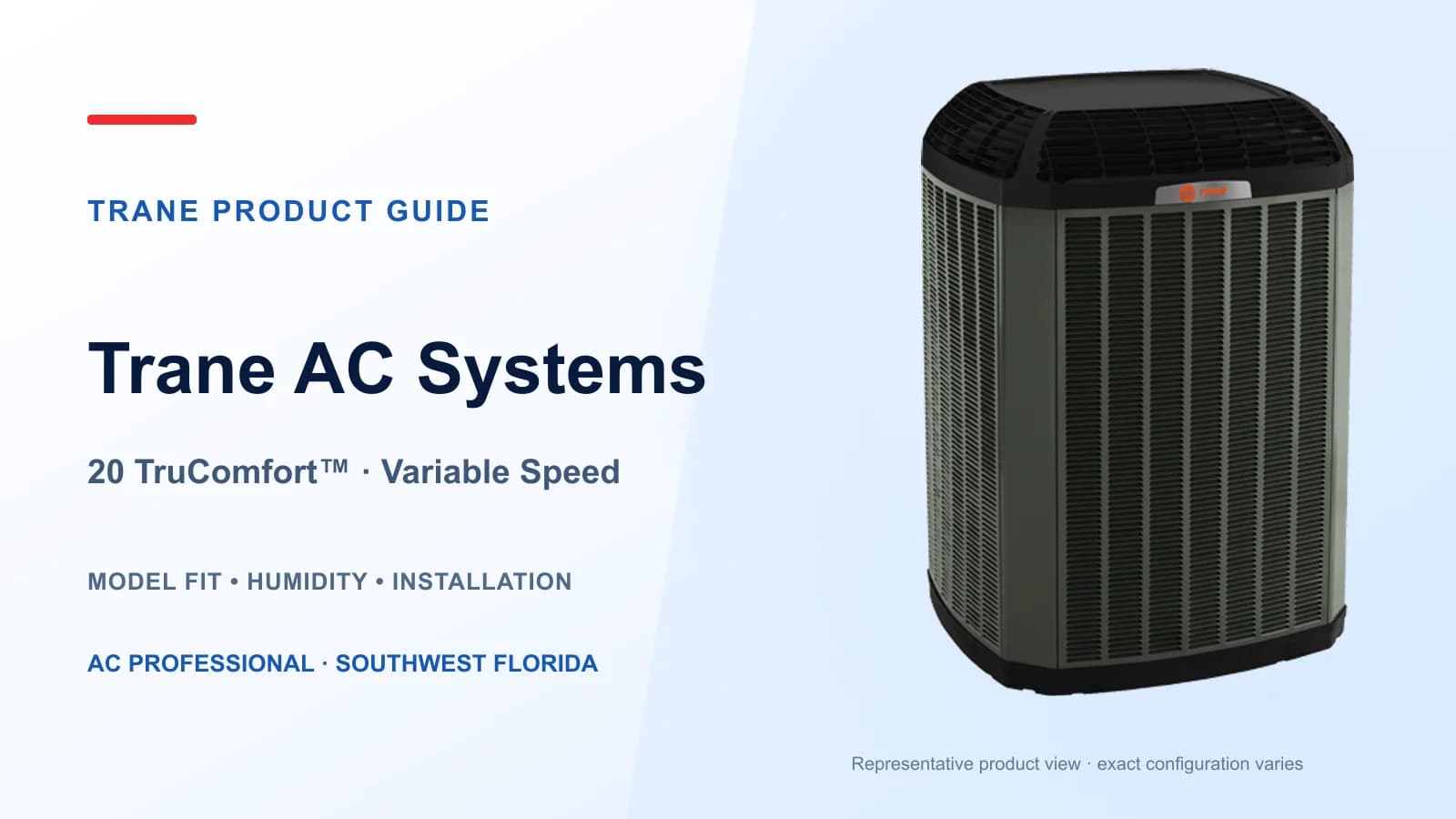
- Trane — Ask about: single-stage, multi-speed, and TruComfort variable-speed tiers. Verify: the operating tier, current refrigerant, matched indoor unit, and control.
- Carrier — Ask about: Infinity, Performance, and Comfort tiers, including selected coastal variants. Verify: whether the quoted model is actually coastal and which features remain in the final matched system.
- Rheem — Ask about: Endeavor Line tiers and EcoNet on selected systems. Verify: the exact Prestige, Classic Plus, or Classic model and EcoNet compatibility.
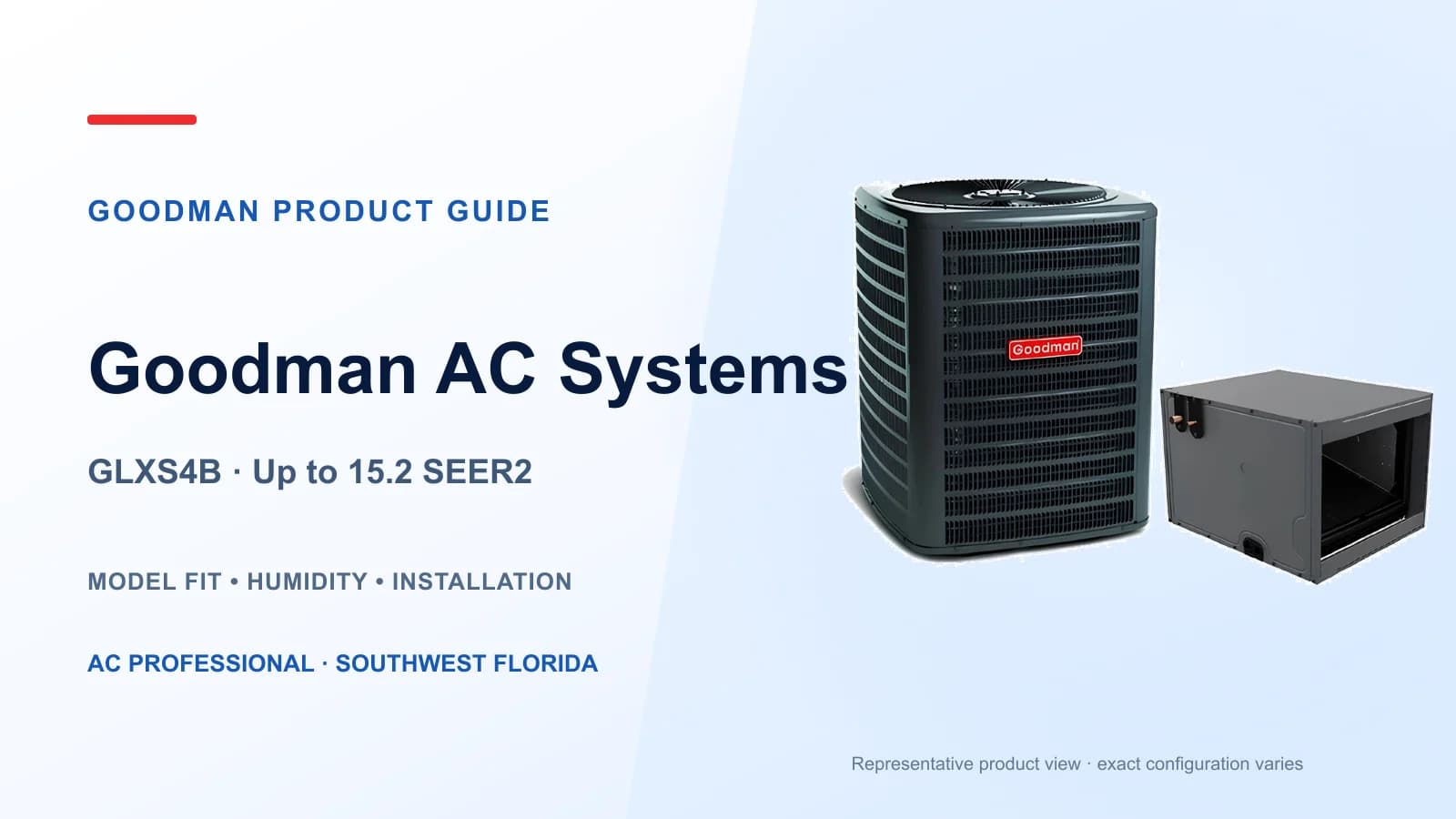
- Goodman — Ask about: a straightforward model-level value comparison and Florida-specific warranty rules. Verify: the exact equipment, labor coverage, and current Florida warranty language.
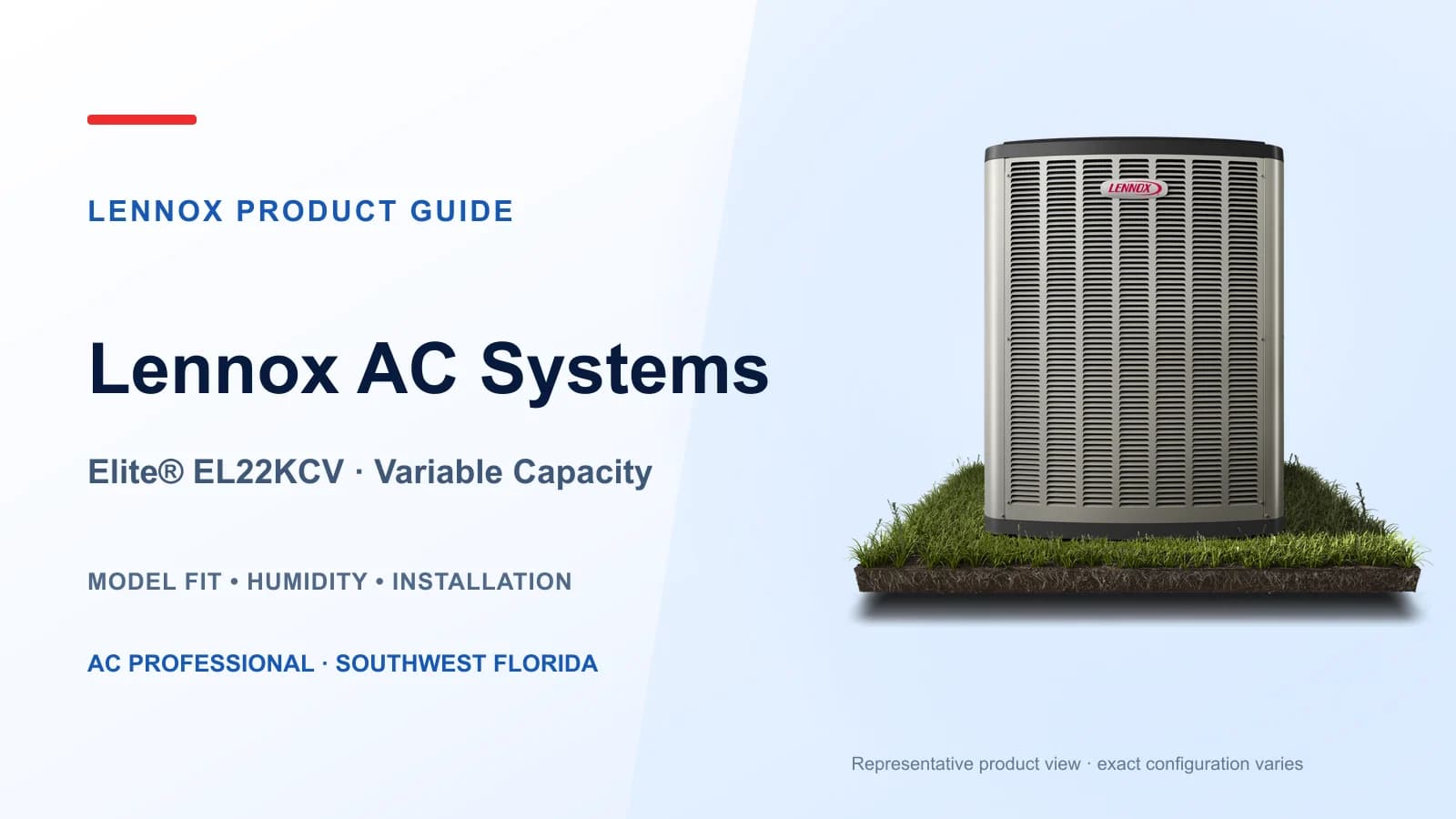
- Lennox — Ask about: current variable-capacity and digital-ready choices such as EL22KCV. Verify: the exact model, control package, matched performance, and published sound conditions.
This is a question guide, not a ranking. Model availability changes, and the AHRI-rated outdoor/indoor combination can change the efficiency and features discussed in a proposal.
What SEER2 Means Without the Jargon
SEER2, or Seasonal Energy Efficiency Ratio 2, compares the cooling a system delivers over a standardized season with the electricity it uses. The official calculation is cooling output in BTUs divided by electrical energy in watt-hours. In plain language, a higher SEER2 rating means more seasonal cooling per unit of electricity and the potential for lower cooling costs than a comparable lower-rated system.
The “2” identifies the updated U.S. Department of Energy test used since 2023. The newer procedure tests ducted equipment against higher external static pressure to better represent field conditions. Because the test changed, an older SEER number and a newer SEER2 number should not be treated as perfectly interchangeable. A shortcut such as “15.2 SEER2 equals 16 SEER” may be useful for rough orientation on some ducted split systems, but the exact matched equipment and AHRI certificate are the reliable comparison.
Is 15.2 SEER2 above the Florida minimum?
For split-system central air conditioners sold in Florida, which is in the Southeast region, the federal minimum depends on cooling capacity:
- Below 45,000 BTU per hour: 14.3 SEER2.
- 45,000 BTU per hour or more: 13.8 SEER2.
- Heat pumps, packaged equipment, and other product categories follow their applicable federal requirements.
Therefore, an AHRI-matched split system verified at 15.2 SEER2 is above those common Florida split-system minimums. The proposal should still identify the outdoor unit, indoor unit, capacity, and AHRI-rated combination because the brand name or outdoor cabinet alone does not establish the installed rating.
Can 15.2 SEER2 lower the electric bill?
It can reduce cooling electricity use compared with a correctly sized, similarly installed lower-rated system, but no percentage should be guaranteed from the rating alone. In one Department of Energy purchasing example for a 36,000 BTU system in a hot-humid region, the modeled 15.2 SEER2 unit used 8,074 kWh per year versus 9,159 kWh for a 13.4 SEER2 alternative—about 12% less under that example’s assumptions.
Replacing an older 10–13 SEER system may produce a larger planning estimate, but old SEER and current SEER2 ratings are not identical tests. A 20–35% figure should be presented as a possible estimate for a specific comparison, not a promised bill reduction. Actual savings depend on sizing, duct leakage, airflow, thermostat settings, maintenance, weather, electricity rates, and the condition of the old system.
Plain-English benefit: 15.2 SEER2 means more seasonal cooling per unit of electricity—and the potential for lower monthly cooling costs when the complete system is properly matched, sized, and installed.
Official Sources Checked for This Comparison
- Daikin residential products
- Trane residential air conditioners
- Carrier residential air conditioners
- Rheem residential air conditioners
- Goodman warranty information
- Lennox residential air conditioners
- ENERGY STAR energy-efficiency definitions
- AHRI guide to the 2023 efficiency standards and SEER2 test
- U.S. Department of Energy regional central AC standards
- U.S. Department of Energy central AC purchasing example
Official manufacturer pages were checked on August 5, 2026. AC Professional does not use a brand name alone to size equipment or promise a feature.